
I produced and directed this film to chronicle the life and expeditions of Norwegian polar explorer Roald Amundsen in the years 1897-1928.
In this award-winning film, I use the camera to explore polar landscapes and seascapes, record oral traditions, reveal human interactions, and evoke states of psychological and physical health. I show just how Amundsen became an agile expedition leader, by learning directly from Canadian Inuit about their polar skills and techniques, and also their management style.
During my film tours, I have seen how the film appeals to people in many disciplines, from Anthropology to Biography, Canadian and Scandinavian Studies, Geography, History, Indigenous Studies, Management, Medicine, Nutrition and Oceanography. Of course, some people come along to screenings purely for the adventure!
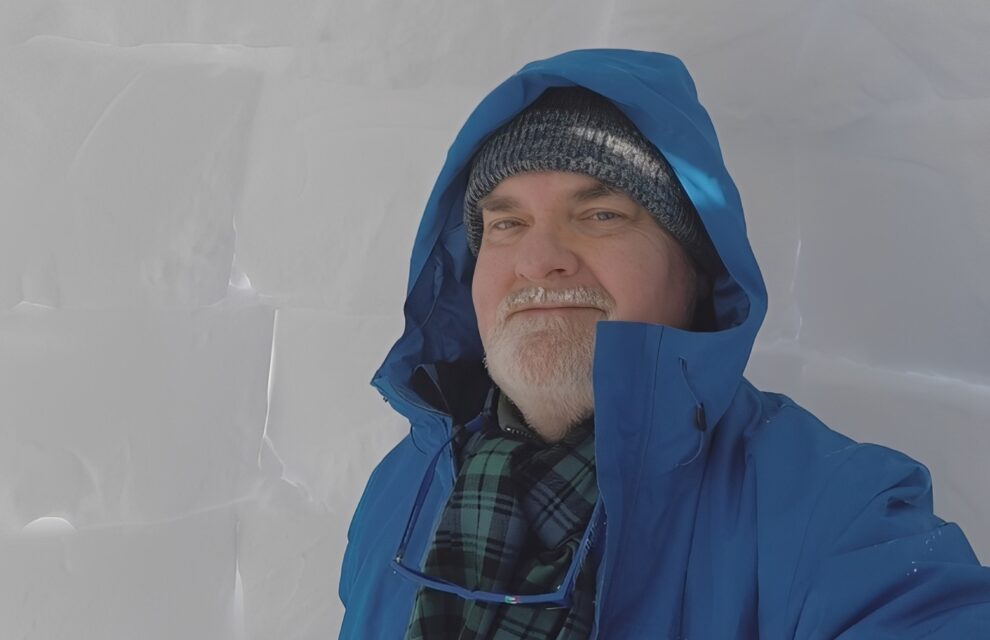
The feature image at the top of this page shows me in Gjoa Haven, Nunavut, while building an igloo with Inuit there.
Here is the film trailer:
Here below is a video and still image gallery of excerpts and out-takes from The Blinding Sea. On this page you can view my original videos from the Southern Ocean, Antarctica, the Beaufort Sea, the Yukon, Nunavut, Quebec, Belgium and Norway. More videos will be added from time to time. Stay tuned!
The Blinding Sea explores the relationship between humans and huskies, which has kept me busy shooting scenes in white-out conditions. In the video segment above, here is dog-musher Louis-Philip Pothier with his dog-team during a blizzard on Baffin Island.
The video segment above is from Svartskog, Norway, where first cousins Johan Leon Amundsen and Anne-Christine Amundsen Jacobsen try on Inuit snow-goggles, made of caribou bone. The Inuit showed Roald Amundsen how to use these snow-goggles to avoid snow blindness, a condition which struck many polar explorers of the time.
Next to Anne-Christine’s house in Svartskog is Uranienborg, the house where Roald Amundsen lived from 1908 to his death in 1928.
In the video segment above, Johan chops wood at his mountain cottage in southern Norway, using an axe Roald Amundsen once gave to Johan’s grandfather Leon.
Researching and making this film means leaving the books behind and heading out to sea. I n this video segment, I sail from Ushuaia in southern Argentina across the Southern Ocean to the Antarctic Peninsula, on the Dutch three-masted bark Europa.
I am fascinated by the sights and sounds of the bark Europa, as we make our way under sail to Antarctica. For me, this is a completely new world.
Roald Amundsen’s first experience of polar exploration was as second officer on the Belgica expedition, commanded by Adrien de Gerlache. Once the long Antarctic night fell, and the icepack of the Bellingshausen Sea began closing in on the three-masted bark Belgica, officers and crew were haunted by a nightmarish vision: they were now in an extremely hostile environment, and might never make it home again. The video segment above is an animation I worked on with Peter Butler, a brilliant 3D animator in London, UK: we scanned a highly pixelated photo from a book in the public domain, removing the Moiré effect, then cleaning it, and adding a blue tint; Peter added moonlight and a lens flare, getting the sea-ice in the foreground to press in on the ship, and adding two spouting whales in the distance.
During the long Antarctic night, expedition commander Adrien de Gerlache often anxiously pictured to himself the Château de Gomery, the seat of his family in Belgium. I visit the château for this film, to interview Adrien’s grandson Baron Bernard de Gerlache.
A documentary film on exploration cannot just recount facts. The Blinding Sea reveals different cultural approaches to knowledge acquisition and to Nature itself.
In making this film, I use every visual means possible to establish a factual record, from video to photographs, engravings, oil paintings, pages from vintage books and newspapers, vintage postcards, satellite imagery, maps, drawings, 3D animations, tapestry and stone carvings.
Each person, each culture experiences and interprets Nature differently. We do not all see the same natural world. The factual record needs to be grounded in the perceptions and experience of the film’s main characters (and occasionally my own). This is the essence of intersubjectivity.
The Blinding Sea places the accent on intersubjectivity, Amundsen’s quest for knowledge, the lived experience of the wilderness, and the sharing of oral traditions. I follow Amundsen’s two-year apprenticeship with Inuit, which involved unlearning what he thought he knew, and then taking practical lessons from Inuit. He recognized Inuit women as vectors of knowledge.
His approach to Nature was in stark contrast to the approach of some other turn-of-the-century European and American explorers, who portrayed their discoveries against the backdrop of the polar sublime, a melancholy Romantic vision of individuals struggling in the awe-inspiring ice-bound wastelands at the ends of the Earth. (By turn-of-the-century, I am referring to the period from 1890 to 1916 or so.)
In my experience, Inuit associate Nature with their spirit world. I know Inuit who believe aspects of Nature are only visible to themselves. Inuit have often told me about their gods, goddesses, shamans, and the Ijiraq, a shape-shifting human-caribou hybrid able to appear, disappear, suddenly growing to a terrifying size in order to deceive hunters:
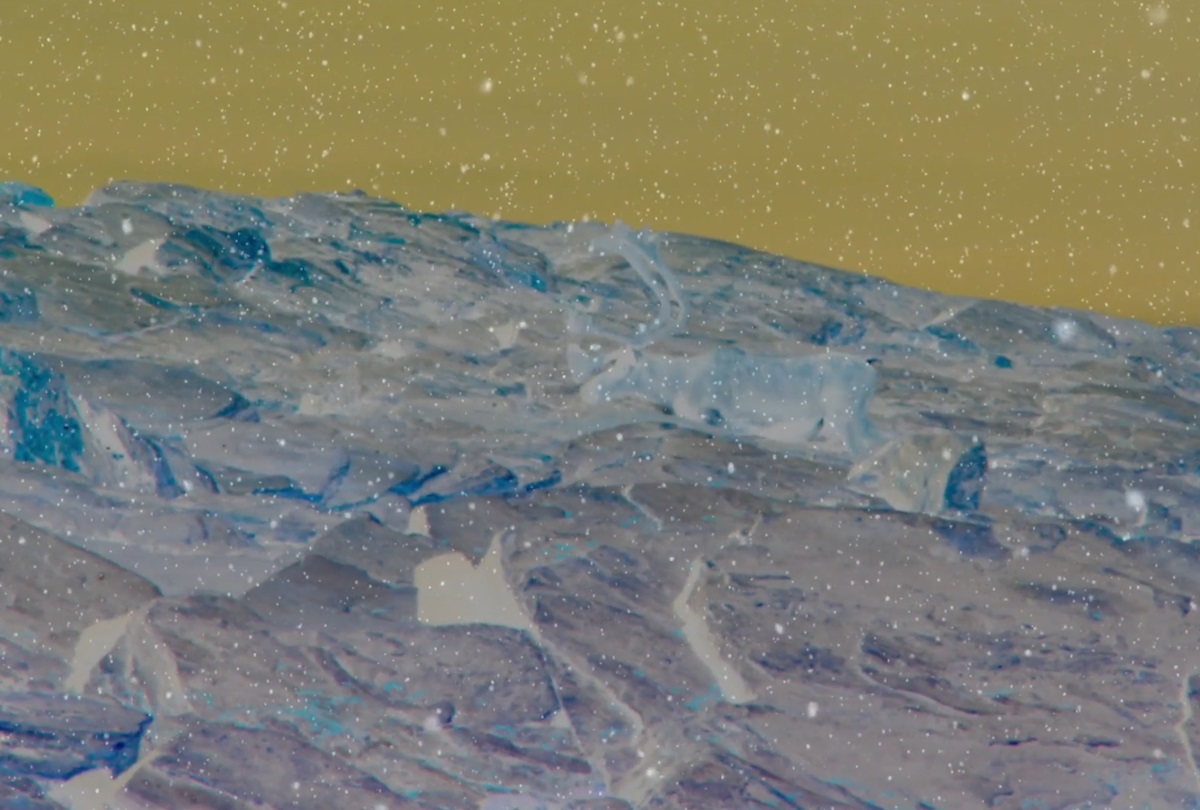
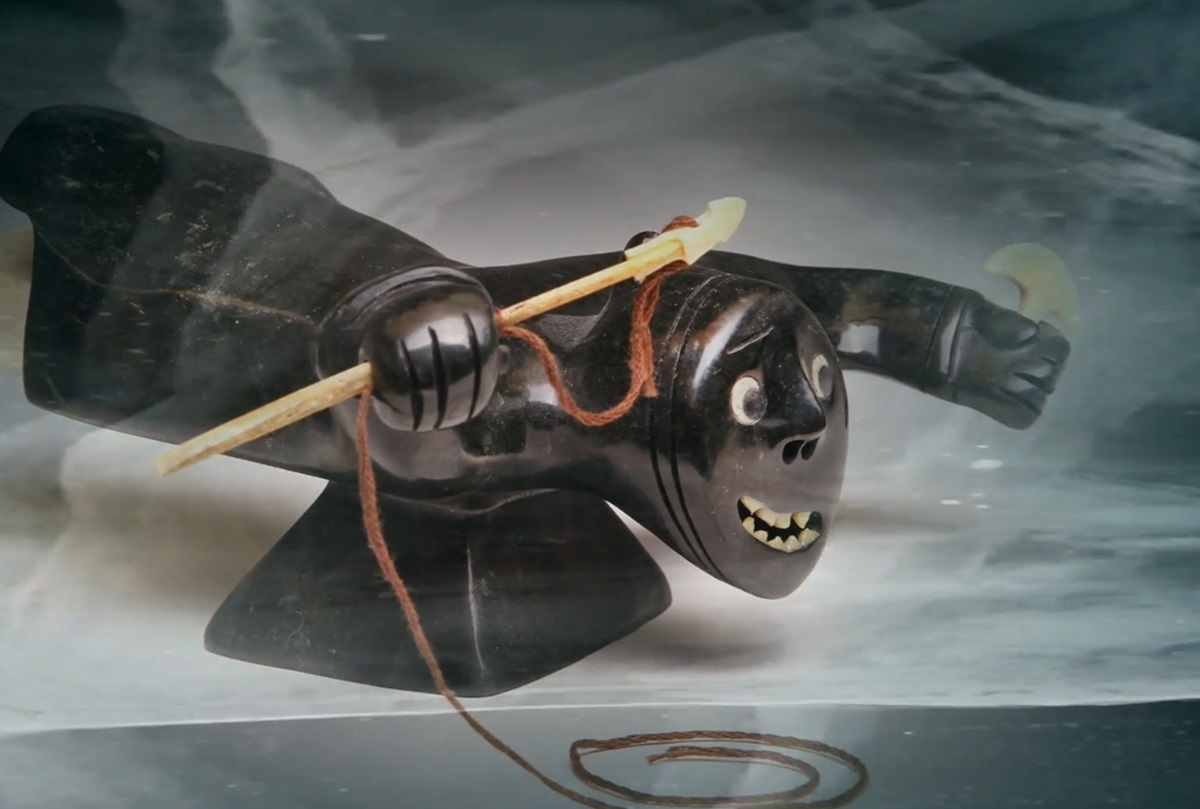
Is it possible to represent the Ijiraq? How as a film-maker should I represent Pinga, the goddess of the hunt and medicine, or Nuna, the goddess of the Earth, or the shaman-hero Kiviuq? Beyond the visual materials I use, evoking myth requires innovative film techniques, from inverting colours to animating still images and creating overlays and double exposures. Like the wandering caribou spirit above (my take on the Ijiraq, using inverted colours and an overlay of snow falling). And the Inuit shaman hero Kiviuq below: I commissioned Inuit artist Damien Iquallaq to make a stone carving for the film, showing Kiviuq swimming below the waves to battle the Inuit sea goddess Nuliajuk and free all the animals she has bewitched. For added effect, a still image of Kiviuq moves from left to right, overlaying a pan of cracks and veins in blue ice.
Wintering in the Beaufort Sea on the Canadian research icebreaker Amundsen gives me a first-hand view of winter conditions in the High Arctic. Initially, I assume the thick sea-ice surrounding the ship is like lake-ice in southern Quebec. Big mistake! Actually, sea-ice is porous, constantly moving under the effect of tides, currents and winds, and subject to being bunched together to create hummocks, and to being torn apart to create patches of open water. So one false step can see me falling into the Beaufort Sea!
The Amundsen is a river-class icebreaker, originally designed for service in the St. Lawrence River and Gulf. The action of breaking the ice throws spray into the air, which actually freezes instantly before falling again. Not surprising, since the air temperature here is -44°C (-47.2°F).
Officers, crew and scientists on the Amundsen take a moment to play soccer on the Northwest Passage. We also play ball hockey on an adjoining rink.
These sun dogs over the Beaufort Sea show what happens when sunlight passes through ice crystals suspended in the air.
In Gjoa Haven, Paul Ikuallaq and his nephew George Konana show me the art of building an igloo or snow house. This is an art Inuit have practiced for thousands of years, and one they showed to Roald Amundsen, who built an igloo during his South Pole expedition when his tent blew down. At the very end of this video, that’s me crawling out of the igloo!
Paul Ikuallaq is full of joy when singing the hymn Amazing Grace for me, in Inuktitut, in the Anglican church of Gjoa Haven.
George Konana takes me dog-sledding on the ice-pack. The temperature today is -50°C (-58°F) and the wind-chill is -68.3°C (-91°F). My cameras freeze, and so do my fingers. This experience gives me an idea how resilient the Inuit are. It also teaches me to respect huskies.
I film some of the dog-sledding scenes for the film in Kluane National Park, Yukon Territory, with dog-musher Sean Fitzgerald of Haines Junction. Dog-sledding can be hazardous! Watch this video to the very end, to see what I mean!
I come across an eccentric skier in the Yukon, who combines dog-power and skis, although not quite the way Amundsen did!
Should Roald Amundsen be considered solely as a lone hero, a polar explorer of legend? But that would be treating him as an abstraction. Wasn’t he also defined, as a person, by his relationships with other people? While making this film I discover that Amundsen legally adopted a Siberian Chukchi girl named Cakonita, during the Maud expedition of 1918-1920. Cakonita in turn had a daughter, Gloria Corbould, who lives in Mexico. I am amazed to meet up with Gloria on horseback in the Sierra Madre mountains.
Amundsen knew great success, but things did not work out that well with the Maud expedition. After two years in the ice north of Siberia, Amundsen returned to Norway with Cakonita, leaving the scientists and crew on board. The expedition continued, but followed an erratic course in the ice and did not manage to drift across the Arctic Ocean as originally planned. Amundsen went bankrupt, the Maud was seized in Seattle for non-payment of debts, and the polar ship was sold to the Hudson’s Bay Company, which ultimately beached her in Cambridge Bay, Nunavut. I visit the wreck by kayak, with a GoPro in hand.
Polar explorers from polar countries like Norway and Canada start out with an advantage. They grow up knowing instinctively about cold weather, and how to equip themselves for expeditions in extreme conditions. Here, I show the approach to Quebec City on the ferry crossing from Lévis, the town where I live. In midstream, we meet the icebreaker Amundsen keeping the St. Lawrence River open for navigation.